

Have you been staring at your screen, wondering how on earth you’re going to navigate the maze of French immigration this year? If you’re feeling overwhelmed by the news that passing the Civic Exam is now mandatory for your long-term stay, take a deep breath. You are not alone in this journey.
For foreign nationals living in France, some major changes to the immigration rules have officially come into effect from January 1st, 2026. Whether you are aiming for your Multi-Year Residence Permit (CSP) or that highly coveted 10-year Resident Card, the rules of the game have shifted, and the Examen Civique is now standing between you and your goal.
If you are applying for the first time, don’t panic. We have mapped out the entire A to Z process step-by-step so that you don’t have to spend another stressful night searching Google. Let’s walk through this together.
📑 What We’ll Cover Together
📝 The Reality of the Examen Civique (What They Don’t Tell You)
Before you let the word “exam” stress you out, let’s look at what this actually involves. This is a 45-minute computer or tablet-based test consisting of multiple-choice questions (MCQs).
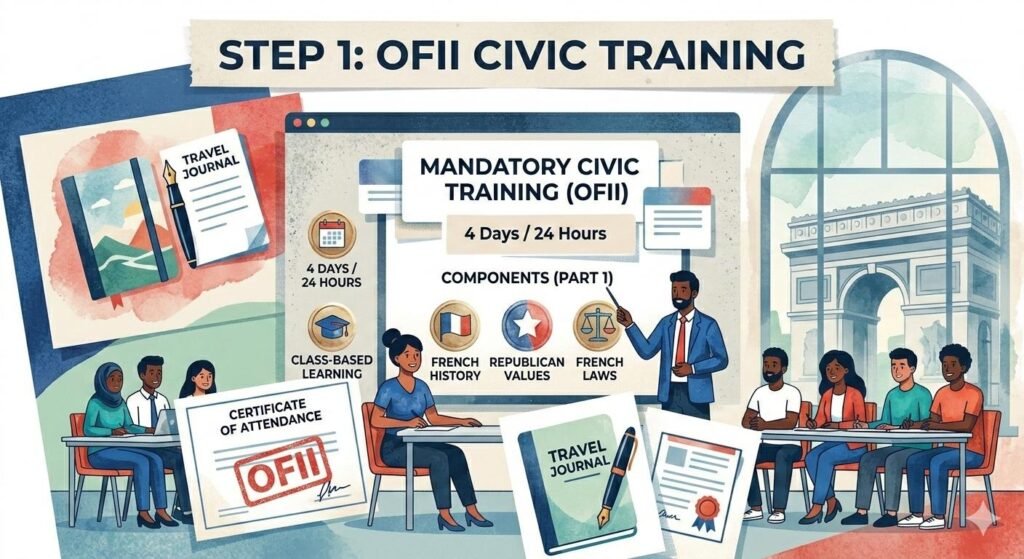
You’ll face 40 questions diving into France’s laws, history, culture, and society. It might sound daunting, but knowing the structure is half the battle won.
- Passing System: You need to secure at least 32 correct answers out of 40 (an 80% passing grade).
- Language: Keep in mind, this exam is conducted entirely in the French language.
- Topics Covered: Expect questions on the core values of the République, fundamental laws, society, and everyday civic life.
“The Examen Civique isn’t designed to trick you; it’s simply a stepping stone to your new permanent life in France.”
It’s vital to note that this exam levels the playing field for everyone.
Now that we’ve demystified the civic side of things, let’s talk about the other major hurdle: the language barrier.
📊 Decoding the 2026 Language Rules: What Level Do You Actually Need?
As of 2026, the French government isn’t just updating civic requirements; the French language rules have also become noticeably stricter.
Depending on your long-term goals in the country, you’ll need to hit specific milestones:
- Multi-Year Permit (CSP): You must prove an A2 Level.
- 10-Year Resident Card: You must prove a B1 Level.
- Nationality (Citizenship): You must prove a B2 Level.
With those foundational requirements out of the way, it’s time to get your hands dirty with the actual application process.
📌 Your Fail-Proof Step-by-Step Guide to the First-Time Form
If you meet the eligibility criteria, following this roadmap will save you endless headaches down the line.
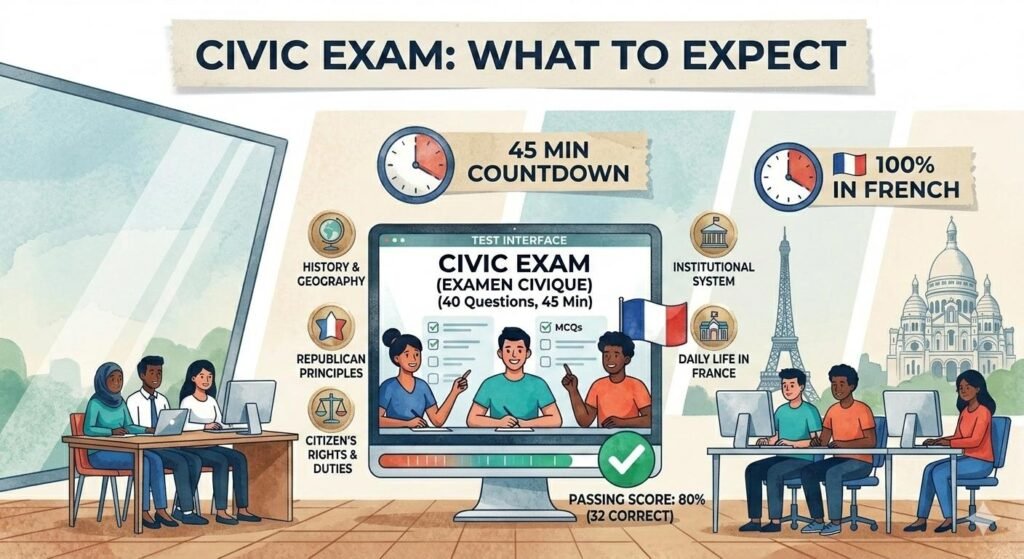
✔️ Step 1: Conquering the Civic and Language Tests
Think of these certificates as the keys to the kingdom. Before you even open the online portal to apply for the residency permit, you must have your passing certificates securely in hand.
- First, complete your mandatory Civic Training under the OFII.
- Next, sit for and pass the Examen Civique.
- Always carry your passport and current Titre de Séjour with you on exam day.
- Once you pass, securely store the official certificate you receive.
✔️ Step 2: Gathering Your Arsenal of Documents
Organization is everything here. Before you start filling out the form, ensure you have pristine scans of the following documents:
- A clear copy of your Passport.
- Your current residence card (Titre de Séjour / VLS-TS).
- Your official e-Photo (the 22-digit code obtained from a designated Photomaton).
- Proof of address, such as an EDF bill or rent receipt.
- Your Examen Civique passing certificate.
- Your French language certificate (A2 or B1, depending on the card).
- The Contrat d’engagement à respecter les principes de la République (This is a newly mandated contract).
- Proof of your job or income, which could be salary slips, a work contract, or a student enrollment letter.
Are you aiming for the big one? If you are applying for the 10-Year Card, you’ll need a few extras:
- Your tax papers (Avis d’impôt) for the last 5 consecutive years.
- Proof of Health Insurance (Assurance Maladie): Log into your Ameli account (CPAM), download the ‘Attestation de droits’, and attach it to prove full coverage.
✔️ Step 3: Navigating the Official Government Portal
With your documents ready, head over to the digital gateway for foreigners in France, the official ANEF website.
You can access it here: Official ANEF Portal
- Log in securely using your Étranger Number.
- Click on the option that says “Je demande ou je renouvelle mon titre de séjour”.
- Carefully select the exact category that matches your situation.
✔️ Step 4: Uploading and Hitting Submit
You are almost at the finish line for the digital portion.
- Carefully fill in all requested personal details.
- Upload the digital copies of your meticulously gathered documents.
- Enter your 22-digit e-Photo code.
- Double-check every single field before you finally hit submit.
“The moment you see that submission confirmation, a massive weight lifts off your shoulders. You’ve done the hard work.”
✔️ Step 5: The Final Prefecture Visit
The waiting game begins, but eventually, you will get the green light.
- Wait for the official notification of your approval.
- Purchase and pay for your Timbre Fiscal online.
- Book your final appointment and head down to the Prefecture in person.
- Hand over your old card and walk out with your brand-new residency permit!
But wait, does absolutely everyone have to go through this civic exam gauntlet?
🚫 The Golden Ticket: Who Gets to Skip the Exam?
There are a few scenarios where you can breathe a sigh of relief and bypass the Examen Civique entirely.
- Renewal Cases: If you are simply renewing an existing card of the same type, you are safe.
- Protection Status: Individuals holding refugee status or under international protection are exempt.
What if you hold one of the elite talent visas? Let’s look at those special conditions.
🔵 Special Rules for the High Rollers: EU Blue Card and Passeport Talent
If you are contributing to the French economy as a highly skilled worker, the administration occasionally rolls out a slightly different red carpet.
- The standard rules might flex slightly depending on your exact profile.
- However, do not assume a full exemption is guaranteed in every single situation.
- The French Master’s Degree Loophole: If you hold a Passeport Talent and have earned a Master’s degree (or any state-recognized degree like a Licence, Master, or Doctorat) from a French institution, you do not have to sit for a separate B1 language test! For the 10-year card, the government accepts your French degree as undisputed proof of your language proficiency.
💡 Wrapping It Up: Your Next Steps to Freedom
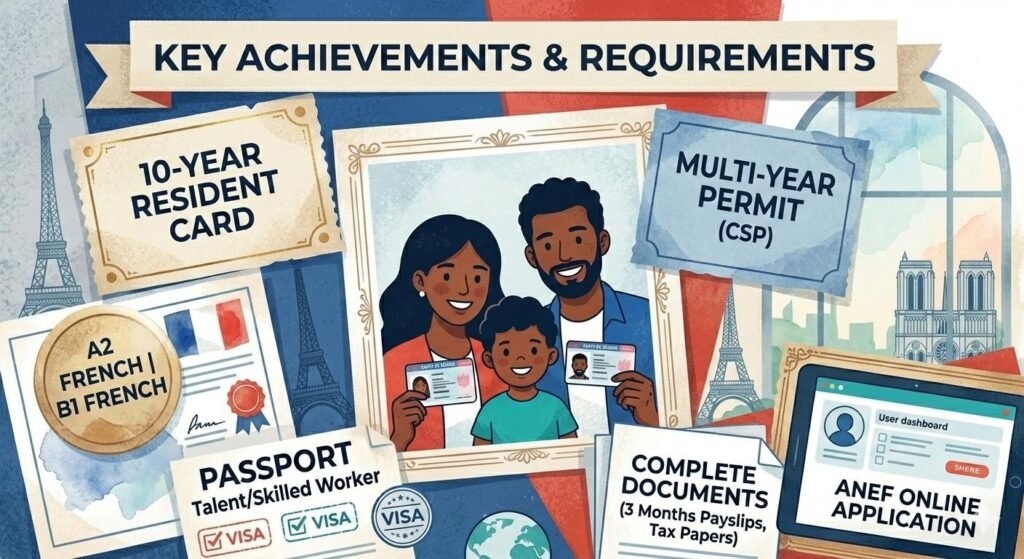
The ultimate goal behind the sweeping 2026 immigration updates isn’t to punish applicants; it is to foster better, deeper integration of immigrants into French society and its beautiful language.
If you tackle your preparation early—getting your exam and language certificates sorted well in advance—submitting your file on the ANEF portal actually becomes a smooth, stress-free experience.
🗝️ Key Takeaways Before You Go
- The Examen Civique is a mandatory 40-question test requiring an 80% passing score, taken only after completing your OFII Civic Training.
- Language requirements have increased: A2 for a standard multi-year permit, and B1 for a 10-year card.
- Without your exam and language certificates, you cannot submit your initial application on the ANEF portal.
- Always begin your preparation and gathering of documents at least 2 to 3 months before your current permit expires!
❓ Frequently Asked Questions (FAQs)
What is Examen Civique and how long is it for?
It’s a 45-minute computer or tablet-based MCQ test. It features 40 questions focused on French laws, history, and society. You must provide 32 correct answers (80%) to pass.
Can this exam be taken directly?
No, according to official regulations, you cannot take this exam directly. You must first complete approximately 4 days (24 hours) of mandatory Civic Training overseen by the OFII.
What are the new French language rules for the Residency Permit?
The rules are stricter as of 2026. An A2 level certificate is mandatory for a Multi-Year Permit (CSP), a B1 level is required for a 10-Year Resident Card, and a B2 level is necessary for Nationality applications.
Do those with a Master’s degree from France have to take the B1 language test?
No. If you hold a state-recognized degree from a French institution (like a Licence, Master’s, or PhD), you do not need to take a separate B1 exam (such as TCF or DELF) for the 10-year card. The degree itself serves as valid proof of your language proficiency.
Who gets an exemption from the Examen Civique?
Exemptions apply to individuals simply renewing their existing card, as well as those under refugee or international protection status. Exemptions for those aged 65 and older are decided case-by-case. EU Blue Card and Passeport Talent holders may also qualify for exemptions, but this must be confirmed with the local Prefecture.


No comments yet. Be the first to share your thoughts!