

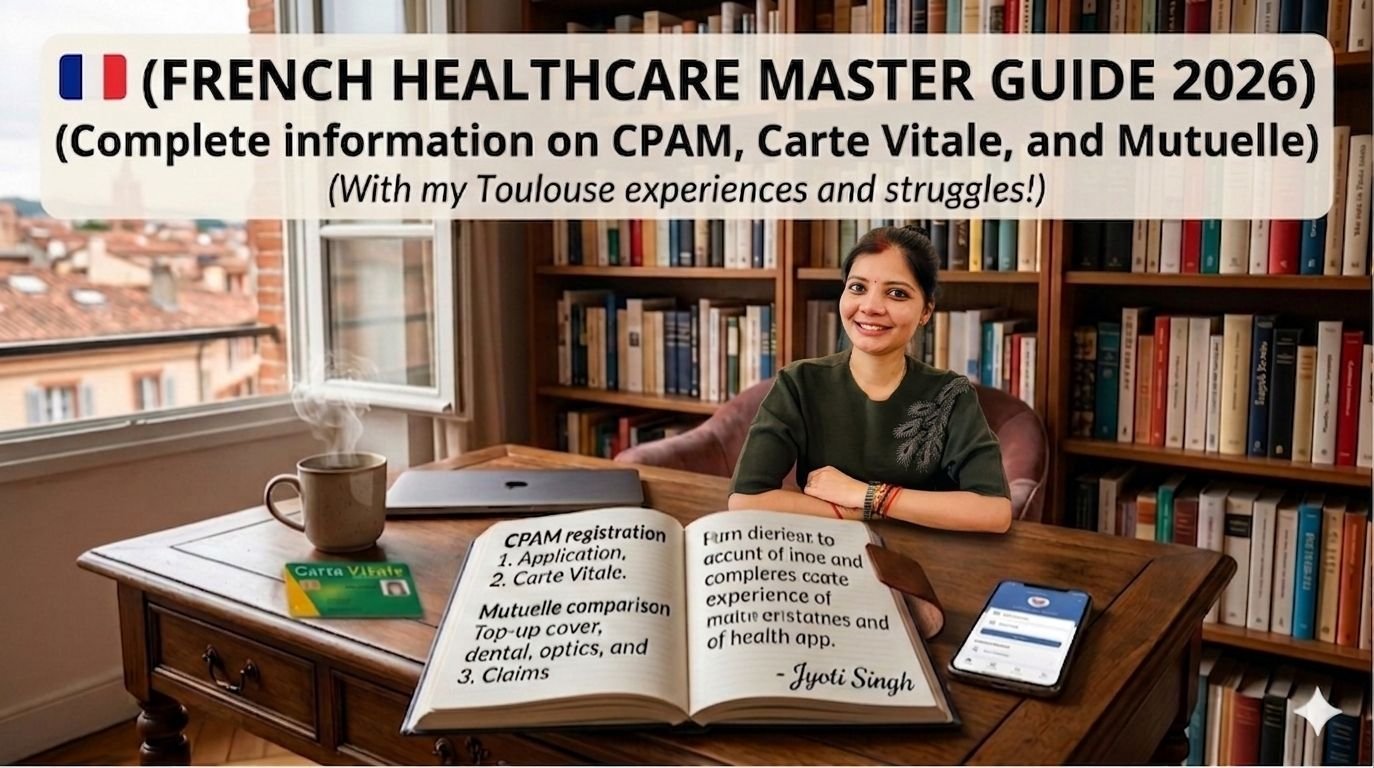
Moving to France isn’t just about changing your coordinates; it’s about installing a completely new ‘operating system’ for your life. The language barrier, the unwritten rules, and the endless paperwork can easily shake your confidence at first. When I first arrived, everything looked like a postcard, but the real challenge began when I had to navigate the French Health System (Sécurité Sociale).
“It felt like navigating an unsolvable maze where the walls kept shifting.”
This blog isn’t just a list of facts—it’s my personal experience. I’m writing this so you don’t have to go through the same struggles and guesswork that I did.
1. Essential Documents to Bring from Your Home Country
Before you even pack your bags for France, make sure you have these papers with you. Without them, the process won’t even start:
- Birth Certificate (with Apostille): You must get an ‘Apostille’ stamp on your original birth certificate from your home country’s Ministry of External Affairs. This is strictly mandatory.
- Marriage Certificate (with Apostille): Required if you are arriving as a ‘Dependent’ with your partner.
- French Translation: A certified French translation of these documents.
2. 🪪 Visa Categories and the ‘Secret’ Mailing Addresses (Paris vs Local)
When you apply for social security and where you send your documents depends entirely on your visa status:
- Passeport Talent & EU Blue Card: You can apply as soon as you land in France. You do not need to wait for 3 months.
- Dependent Visa (Spouse – VLS-TS): You must prove you have lived in France for at least 3 months. Your application will be processed at your local city’s CPAM office.
- Student Visa: Students have a dedicated portal (etudiant-etranger.ameli.fr).
3. 💡 The Golden Tip for Applying
4. 📝 How to Apply for the First Time (Step-by-Step)
Step 0: The Ameli Website: Start by reading the official guidelines on ameli.fr.
Step 1: The Form (Cerfa S1106): Carefully fill out the application Form S1106.
Step 2: Document Checklist:
- Passport + Visa + Validation (VLS-TS).
- Birth Certificate (Apostille + Sworn Translation).
- Work Contract / Salary Slip (if you are employed).
- Proof of Residence (dating back 3 months).
- RIB (French Bank Account details) and a valid ID photo.
- Marriage Certificate (if applicable).
- Attestation d’hébergement (if you are staying at someone else’s house).
Step 3: Where to Send It? Mail it to your local office (or the Paris office for Passeport Talent). Always use “Lettre Recommandée avec Avis de Réception” (Registered mail with acknowledgment of receipt) so you have proof of delivery.
5. ⏳ The Journey to Getting Your Card: Temporary vs Permanent
- Temporary Number: A few weeks after applying, you will receive a temporary social security number (starting with a 7 or 8).
- Permanent Number: This can take anywhere from 3 to 6 months. Only then can you create your online Ameli account.
- Carte Vitale: Once you upload your photo online, your physical green card will arrive in the mail within 2-3 weeks. Until then, use your paper “Attestation de droits” as proof of coverage.
- Feuille de soins: If you visit a doctor before getting your card, you must pay upfront. Ask the doctor for a brown paper form called a Feuille de soins. Fill it out, mail it to CPAM, and they will transfer the refund to your bank account.
6. 💶 Refunds and Doctors (Sector 1 vs Sector 2)
- Sector 1 Doctor: They charge the government-approved base rate (around 26.50€). You have the highest chance of a full refund here.
- Sector 2 Doctor: These doctors can charge extra fees at their discretion (dépassements d’honoraires). CPAM will only refund the base rate; the extra cost is out-of-pocket unless your Mutuelle covers it.
7. 🛡️ What is a ‘Mutuelle’ and Why Do You Need It?
- Linking your Mutuelle (Télétransmission): Send your “Attestation de droits” to your Mutuelle provider to activate the link. Once linked, CPAM and your Mutuelle communicate automatically, so you don’t have to claim refunds manually.
- Tiers Payant: If your card is updated and your Mutuelle is linked, you won’t have to pay out-of-pocket for most prescription drugs at the pharmacy (Cashless).
- “100% Santé”: With a Mutuelle, you get access to this reform, which provides fully reimbursed basic glasses, dental crowns, and hearing aids.
8. 💊 The Pharmacy and Your ‘Mise à jour’
Updating Your Card (Mise à jour): You need to update your Carte Vitale 1–2 times a year. Simply walk into any pharmacy, find the small green terminal, insert your card, and follow the screen. This is vital to ensure new data (like a newly linked Mutuelle or a newborn baby) is physically synced to the chip.
9. 👨⚕️ Médecin Traitant (Primary Doctor) and My Toulouse Experience
You must formally declare a primary care doctor (Médecin Traitant); otherwise, your refund rates will be heavily penalized.
When I was in Toulouse, my French was weak, and every doctor on the Doctolib app showed up as “not accepting new patients.” Eventually, a friend recommended a clinic, and I just walked in and pleaded my case at the desk. It worked.
“Sometimes showing up in person and smiling goes a lot further than clicking a screen online.”
10. 🤰 Special Coverage (Pregnancy, ALD, and Kids)
- Pregnancy: Declare your pregnancy before 14 weeks. From the 6th month onward, 100% of your medical expenses are covered.
- ALD (Long-term illness): Chronic conditions get special 100% coverage routes.
- Kids: Children do not get their own card until they are teenagers; their social security number is attached to the parents’ cards.
11. 💳 What if Your Card is Lost or Damaged?
Log into your Ameli portal, click ‘Signaler la perte’ (Report a loss), and order a replacement. Until the new one arrives, print and show your paper attestation to doctors.
💡 Bonus Hacks You Should Know
- FranceConnect: Once you have a permanent number, use this system. It allows you to use one single login for almost all government services (taxes, health, etc.).
- Mon Espace Santé: This is your digital health record. Securely store all your blood tests, X-rays, and prescriptions here.
- European Health Insurance Card (EHIC): Traveling outside France but within Europe? Order this free card from Ameli before your trip to ensure you are covered abroad.
12. 🚑 Crucial Emergency Numbers
- 📞 15 – Medical Emergency (SAMU)
- 📞 18 – Fire Brigade (Pompiers)
- 📞 112 – General European Emergency Number
- 📞 114 – Emergency SMS (for deaf/hard of hearing)
Final Thoughts
The French health system is honestly world-class, but the initial paperwork requires a lot of patience. Once you’re set up, always carry these 3 things in your wallet or phone: your Carte Vitale (updated), your Mutuelle Card, and a PDF of your Attestation de droits.
If you’re stuck on a form or facing a roadblock with CPAM—drop a question in the comments below! 😊
📌 Key Takeaways
- Always bring your Apostilled Birth and Marriage Certificates from your home country.
- Passeport Talent visa holders bypass local offices; their paperwork goes directly to Paris.
- CPAM only covers 70% of costs; securing a Mutuelle (Private Insurance) is essential.
- To maximize refunds, declare a Médecin Traitant (primary doctor) and do a Mise à jour of your card at a pharmacy 1-2 times a year.
Frequently Asked Questions (FAQs)
1. What are the most important documents needed for French health insurance?
You will fundamentally need an Apostilled birth certificate (translated into French by a sworn translator), your Visa/VLS-TS, proof of residence (dating back 3 months), French bank account details (RIB), and an employment contract if applicable.
2. What is the difference between a Sector 1 and Sector 2 doctor?
Sector 1 doctors charge the standard government-approved rate (around 26.50€), ensuring maximum basic reimbursement. Sector 2 doctors are allowed to charge higher, unregulated fees, and the extra cost is only covered if you have a private Mutuelle.
3. What is a Mutuelle and is it mandatory?
A Mutuelle is a private top-up health insurance. Because the public system (CPAM) usually only covers 70% of standard medical costs, having a Mutuelle is highly recommended (and practically mandatory) to cover the remaining 30% and additional fees.
4. How do I perform a ‘Mise à jour’ on my Carte Vitale?
You can update your card by taking it to any pharmacy in France. Look for the small green terminal (borne), insert your card, and let the machine sync your latest details. This should be done 1-2 times a year.




[…] ✔ Must have applied for Social Security (temporary number also works)(If you haven’t applied for CPAM yet or want to understand the process, you can read my detailed guide here: The Complete Guide to CPAM & Carte Vitale) […]
[…] Before reading this, definitely read my ‘France Health System Guide‘ and ‘CAF & Family Benefits‘ […]